A frightful mess of blood, gore and science gone awry, the Zombie Tacomapocalypse was a huge success for the mad, world-ending geniuses at Treefish Studio. An art show to end all art shows (not to mention the world itself), the first Tacomapocalypse was a thing of surprising beauty, and the launch party was just the shindig to send the world out on.
But, a year has passed and the world seems to have forgotten that it ended. So now – just like the Rapture – it’s happening for a second time: tonight, from 5pm-9pm, Tacomapocalypse II launches at Amocat Cafe.
Described as “a humorously macabre art show” by one of the open calls for arms art, this year’s Tacomapocalypse will feature live music by Gibson Starkweather, a mob of fully re-animated zombies, tasty snacks (including your own brain) and a horde of flesh-eating artwork depicting zombies, ghouls, The End of the World as We Know It™, Tacoma and possibly a dash of love. Because you just can’t bring the world to an end unless you love it enough to tenderly caress it as you stab it to death, re-animate it and set about fulfilling your evil, sadistic plans of doom and mayhem. [Editor's Note: The end of the world may or may not contain actual love. Possible alternatives include sadistic infatuation and bloodlust.]
Though last year’s show failed to permanently end the world, 2012′s Tacomapocalypse II – predicted by the ancient Mayans long ago – is sure to stop the orbit of the Earth, freeze the sun solid and implode the very fabric of our reality.
And if not, there’s always next year.
Official Press Release:
Tacomapocalypse II, the second darkly humorous group art show hosted by Treefish Studio and Amocat Cafe, begins February 3rd, 2012 at Amocat Cafe, 625 St Helens Ave, Tacoma WA. Two- and three-dimensional art featuring apocalyptic themes by local artists present a bold alternative to the Valentine decor more commonly expected at this time of year.
Opening festivities begin at 5:00 PM, and will include snacks, additional artists on hand, live electronic music featuring Gibson Starkweather, a zombie horde, and other special features and shenanigans, to conclude around 9pm.
Tacomapocalypse II runs through February, and is viewable during Amocat’s regular winter hours of 7 to 2:30 Monday thru Friday, and during special events as they happen (Such as the monthly music events. See their page at AmocatCafe.com for updates and further details.)
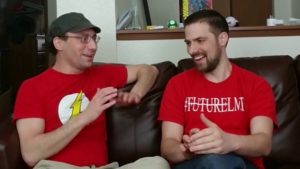
The NT Crew – Paul and Gordon of Norman Tweeter Productions – attended the midnight showing of Green Lantern last night. They talk about the history of the film, the trailers, the characters and, of course, whether or not it’s a good movie (for comic fans and non-comic fans alike).
The fine folks of Norman Tweeter Productions and I filmed this review back in October, but due to various circumstances were unable to complete it until now. (Circumstances include, but are not limited to: holidays, upgrading software mid-project, the fact that it’s their video but was edited on my computer…and life in general.)
The clips of the firemen, the fire and the people dangling from a rope off a skyscraper are all public domain footage and can be found on archive.org.
No longer is it merely a place to sit, drink, eat and be local. For the month of September, Amocat is a port – a harbor for seafaring artwork. Docking on its walls are nautical scenes of varying shapes and sizes. Some of the intricately rendered ships float on framed canvas, while others drift across the surface of wood that itself has lived in the salty scenes they now immortalize.
'First Command' is one of several paintings depicting a portion of an adventure story that will be released by Treefish Studio in the near future.
All through the month of September, Amocat Cafe is displaying the art of local artist Stuart M. Dempster. Along with his fiancée, Kendra, Dempster comprises half of Treefish Studio. He considers this show a bachelor party of sorts, calling it his “last solo sail” before rolling all of his artistic endeavors into the Treefish fold.
“This is the culmination of seven years of showing my art,” says Dempster. “A lot of pieces in the show have stories behind them.”
In fact, several of the pieces have, according to Dempster, “an actual, literal story behind them.” Pieces such as First Command and Shore Party depict scenes from an adventure story that Dempster plans to release in the form of a graphic novel or webcomic, which will be brought to life with Kendra’s aid as part of Treefish Studio.
I have been privileged to know Dempster for almost a year, now. In that time, I have seen him do many amazing things. A jack-of-all-arts, he sees potential in nearly any material put in front of him, and doesn’t shy away from experimentation. Whether it’s rigging a makeshift recording studio in the garage, constructing a ramen cart from scratch or bringing to life the ships displayed in Amocat this month, Dempster approaches his projects with equal fervor, frustration, giddiness and passion.
Stuart M. Dempster
When asked what he enjoys about making art, he responded that it’s not something he simply enjoys.
“I do enjoy it, but that’s not why I do it,” elaborates Dempster. “I do it because if I don’t, I’ll go bug nuts insane!”
“If I don’t do it, it hurts,” he explains. “Art needs to be done.”
Dempster’s show officially opens in an event beginning at 4:30 this afternoon. Amocat Cafe can be found at 625 St. Helens Ave in Tacoma. For more information on Dempster, Treefish Studio, Amocat Cafe or today’s event, click on the links below:
The story revolves around a group of twelve brain-whammy super-powered types called the FreakAngels who were somehow responsible for the end of the world. The details of how and why are not initially disclosed, but the result is a story that gets the lovely setting of a flooded, post-apocalyptic London. All of this is beautifully rendered by Paul Duffield, who I had quite sadly never heard of before. His art is lovely, and Ellis’s writing is, well…splendidly Ellis. So go read the comic. You won’t regret it.
All that aside, the point of this post isn’t to go on about how Ellis is an effing genius (which he is), nor how Duffield’s art is fantastic (though it is quite nice to look at) or even how FreakAngels is proving to be a really enjoyable read (again, go check it out). The purpose of this is to talk about the creative process.
I still get asked with appalling regularity “where my ideas come from.”
Here’s the deal. I flood my poor ageing head with information. Any information. Lots of it. And I let it all slosh around in the back of my brain, in the part normal people use for remembering bills, thinking about sex and making appointments to wash the dishes.
Eventually, you get a critical mass of information. Datum 1 plugs into Datum 2 which connects to Datum 3 and Data 4 and 5 stick to it and you’ve got a chain reaction. A bunch of stuff knits together and lights up and you’ve got what’s called “an idea”.
And for that brief moment where it’s all flaring and welding together, you are Holy. You can’t be touched. Something impossible and brilliant has happened and suddenly you understand what it would be like if Einstein’s brain was placed into the body of a young tyrannosaur, stuffed full of amphetamines and suffused with Sex Radiation.
That is what has happened to me tonight. I am beaming Sex Rays across the world and my brain is all lit up with Holy Fire. If I felt like it, I could shag a million nuns and destroy their faith in Christ.
From my chair.
See, this is the good bit about writing. It’s what keeps you going. It’s the wild rush of “shit, did I think of that?” with all kinds of weird chemicals shunting around your brain and ideas and images and moments and storyforms all opening up snapsnapsnap in your mind, a mass of new and unrealised possibilities.
It’s ten past two in the morning, and I’m completely wired, caught up in the new thing, shivering and laughing and glowing in the dark. Just as well it’s the middle of the night. No-one would be safe from me right now. I could read their minds and take over their heartbeats with a glare.
Faster than the speed of anyone.
That’s how it works.
This is, quite possibly, the best description of the creative process I’ve ever seen. When you get an idea, and even moreso when you’re actually working to implement that idea, it is exactly like that. This is how I feel when I’m creating, whether it’s alone or with collaborators. When things just fall into place and inspiration is like a plentiful drug that just keeps being dumped into the room for free, it feels like that. It doesn’t matter if I’m writing, video editing, drawing or what have you. It doesn’t matter if I’m alone in my room or out getting chalk all over my clothes on a city street with a dozen other people. It doesn’t matter if I’m the brains behind the operation, or focusing on the seemingly small task of perfect spotlight operation for a theatrical production.
All of it, no matter how big or small, no matter what it is or who else is involved…it feels just like that. Exactly as Mr. Ellis describes.
It has a life of its own. It makes you feel powerful, it makes you feel like the world is yours to create or destroy. But in the end, you are not the one in control; you’re a pawn, whose only purpose is to bring the magic to life. It takes you along with it, through every sensation that Ellis describes and so many more, and you just have to hope that you didn’t lose your phone and all of your spare change on one of the last seven loop-dee-loops.
It’s a rush like no other, and I truly hope everyone experiences it at least once in their life.
One of the advantages to the “If I Can Dream” experiment is that it offers its audience the chance to really see the power of editing. As an editor and a viewer, I find it interesting to see the chopped up versions of things I watched live.
The “Lost in L.A.” clip is a perfect example – I watched this occur on the live stream, flipping back and forth between the cameras. Normally, editing can improve something like this, by taking out long gaps and repetition. However, in this case, watching it live was more amusing.
Many of the shots here – especially the “Why is the light off?” bit – lose a lot of the humor and reality of the moment by being inserted, out of context, into a spot in the continuity that it didn’t actually occur.
For a show striving to be different in so many ways from standard “reality” television, I think the editors here took too many liberties in re-ordering shots. The only cuts it really needed were for length. The content of the actual, real moment had me cracking up. Sadly, the edited version is a letdown, and comes off like a standard scene from a more generic, less interesting reality show.
I gave this whole experiment a chance in spite of my doubts, and much to my surprise, I found myself enjoying it. As such, I hope this kind of editing doesn’t herald what I should normally expect.
Leave the heavy editing for the weekly compilation episodes. Give us the rest as raw as possible.
More than a week ago, I was lucky enough to attend a press screening for Spider-Man 3 (I must say, I will miss the press screenings when the end of the term arrives and I’m no longer on the paper). Below, you’ll find my review both as it was published in The Clackamas Print, and in text format below that. I did tweak the text format a bit – some parts of the final draft of the article were mysteriously absent when we were about to finalize the page. I fixed most of it, but missed a few things toward the end.
This review as it appeared in The Clackamas Print.
Three villains. Five plotlines. One monumental success for everyone’s friendly neighborhood Spider-Man.
Traditionally, the third movie in a comic book franchise tends to be a disappointment. Just take a look at X-Men: The Last Stand, Batman Forever and – arguably the worst of the bunch – 1983′s Superman III.
At first glance, Spider-Man 3 seems poised to follow its third-child predecessors into the land of movies that fans pretend don’t exist. Third movies of this genre typically hit giant potholes – and plot holes – in the form of too many villains, too many convoluted plotlines, money-grubbing studio interference and the absence of whatever talented director made the first two movies successful.
Spidey’s latest encore skillfully swings its way around such foibles: Sam Raimi returns to the franchise for a third time – a rare feat for directors of comic book films – taking on the challenges of numerous villains and dangling plotlines and weaving them into a surprisingly organized and intricate story.
It is true that Spidey 3 fails to surpass the majesty of Alfred Molina as Doctor Octopus, the drama of Peter Parker hanging up his tights, or any other element of the prior sequel. To be fair, however, Spider-Man 2 set the bar unrealistically high. Moreover, that movie didn’t have to contend with the problems of tying up loose ends while coping with several brand new plots.
At the beginning of the new installment, the much-maligned and misunderstood Spidey of past movies is long gone: the city loves him now, and even J. Jonah Jamison can’t call him a crook anymore (as much as he’d like to). He’s preparing to propose to Mary Jane, who’s found her own success starring in the premiere of a Broadway musical. And on top of all that, the web-head is about to be issued the key to the city.
Unfortunately, it’s all downhill from there: between iconic Spider-Man staples such as the black symbiote, The Sandman and Eddie Brock – the man better known as Venom – Spidey’s life is already thrown into turmoil.
But then there’s still the ongoing storyline of former pal Harry Osborn’s grudge against the web-slinger and yet another tension-filled plot surrounding Mary Jane.
That’s a whopping five plotlines in a franchise that previously had, at most, three simultaneous plots.
It’s the miracle of the movie, really. The first Spider-Man movie stumbled its way haphazardly through the balance between the original story and the Green Goblin. This installment, on the other hand, maneuvers carefully through a number of interconnected relationships and events with incredible grace.
With that considered, Spider-Man 3 is absolutely amazing – vastly superior to the first installment, and not too far behind the second. If the franchise were to end here – it doesn’t have to, but it could – Spidey could gloat that he survived the comic book trilogy curse.
What follows is my profile on Devin Graham from The Clackamas Print. The text version of the article is below the image I took from the PDF – I did alter one sentence in the text version, though. There was a redundancy in the article that went to print that neither I nor anyone else caught.
Standing before the crowd assembled in Portland’s Hollywood Theatre, filmmaker and former Clackamas student Devin Graham glowed with excitement.This was his night – his film.
After months of shooting, several complete plot overhauls and enough frustration to kill a promising career, it was suddenly all worthwhile.
“I realized,” Graham remarked later, “this is why I’m doing it: when you get out on the stage and you realize how many people support you and everybody who’s helped you get to that point.”
Though he had experimented with movies before, Graham first realized his passion for film during a church mission trip to Jamaica.
“I got really into photography there,” he said. “After my mission, I realized how much I loved it and wanted to pursue it as a career.”
Allowing the idea to take root, Graham set out turning a burgeoning dream into reality. He recruited family and friends (and friends of friends) to help with a variety of different projects with which to hone his skills.
Among other things, he completed a film about miniature people that relied heavily on green screen, shot a promotional segment for the Speech Department (in which he was active), served as a cameraman on the self-defense film Just Yell Fire, and was even flown to North Carolina to shoot a project for the truck company Freightliner.
It was during his time at Clackamas, amidst these other projects and his classes, that Graham’s crowning achievement to date really gained a life of its own.
Passion: a movie shot to look like a documentary of fictional events.
It was this movie, a tale about Oregon passing a law prohibiting dancing, that premiered at the Hollywood Theatre on Dec. 29.
“Everybody’s dream is to make a movie,” said Graham. “Everybody talks about how they’re going to do it, but nobody does.”
“A lot of people look at me and say I can’t do it,” he continued, “that it’s too hard, or no one else makes it. But I want it more than anything else, and I’m willing to do what it takes to get it and to prove that you can really make it if you want it bad enough.”
“He’s one of the most driven people I know,” said Adam Young, who first met Graham when some of his friends told him to come along to a shoot. “When he starts a project, or anything for that matter, he puts his whole self into it.”
But even Graham’s determination took its fair share of knocks on the bumpy road to Passion. The plot was revised several times as the project expanded, and when Graham was faced with the deadline of his departure for Brigham Young University, doubt mounted.
He recalled, “I kept wondering, ‘Is this even worth my time? Why am I doing this?’ Pursuing my goal as a filmmaker can be very discouraging at times. I often feel like I am trying so hard and getting nowhere.”
“However,” he added, “it’s all worth it when you get to show your movie on the big screen.”
And Graham certainly isn’t one to settle for any screen smaller than enormous.
“I don’t want to be an independent filmmaker,” he said. “A lot of people say they want to be an independent filmmaker. I want the world to see my movies, and if I’m an independent filmmaker I can’t do that, so I’m not going to be happy until I make it.”
After Passion premiered, Graham headed off to BYU in the hopes of getting into what he describes as an excellent film program there – but that wasn’t the only reason he chose that route.
“I don’t want anything that would take away my morals or values,” he explained. “I knew that [BYU] would help me not lower my standards. And that’s something that’s really important to me.”
While Graham has yet to be fully accepted into the Provo, Utah college’s film program, he hasn’t been sitting still.
In addition to assorted activities in Provo, he has been planning for future ventures. He’ll be returning to Oregon for the summer, where he intends on shooting several new projects.
And then there’s still Passion – treating December’s premiere as what the film industry would call a prescreening, Graham has listened to the comments of his audience and intends to create a new cut of the film.
“In my opinion, it’s going to be a completely different movie – but better,” he said, adding that there are still some things he needs to re-shoot come the summer.
“This is what I love doing, more than anything in the world. And if I can make a living doing what I love, then I’m going to do it.”